Destination Thailand Visa (DTV) – Thailand’s 5-Year “Digital Nomad” Visa
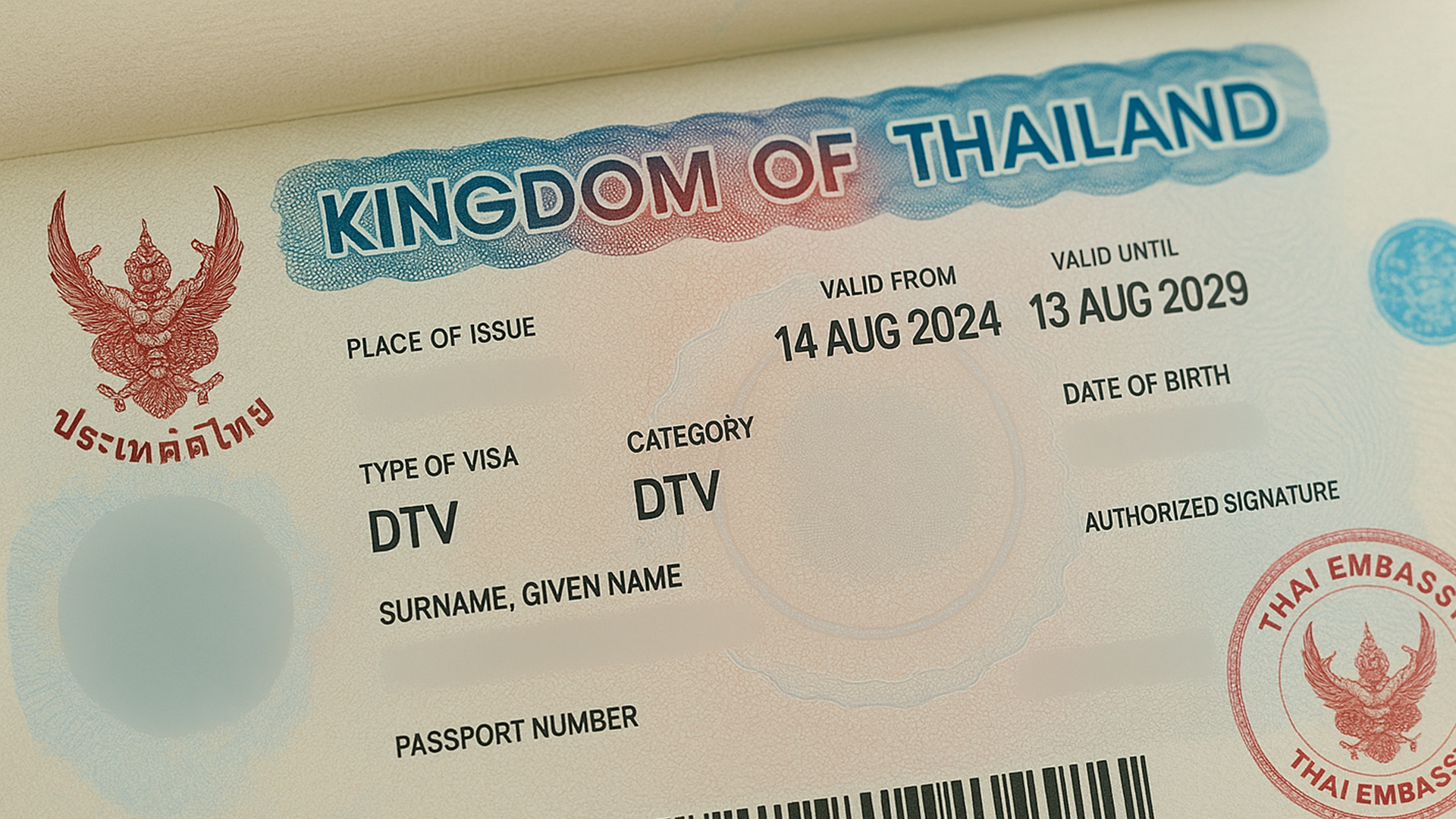
In 2024 Thailand introduced the Destination Thailand Visa (DTV) – a visa that finally fills the gap for remote online workers and digital nomads. This is everything you need to know about the DTV.
TLDR; it’s a five-year, multiple-entry visa that lets you stay in Thailand up to 180 days per entry, extendable by 180 additional days (for a total of 360 days without leaving the country).
It’s often called the “digital nomad” visa because online workers have been dreaming for such a visa for many years (but it’s not just for digital nomads). Staying long term in Thailand has been increasingly difficult over the past decade, with the exception of the Thailand Privilege Visa (Previously called the Thailand Elite Visa).
With all that said, it’s still new, there are some issues, and we’re personally unsure how long it’ll be around in its current state. It has already changed once: since 31 August 2026 you need proof of permanent residence in the country you apply from, plus a criminal record certificate (more on both below).
If you’re considering a move to Thailand, the DTV is one of the most flexible options available. It is already becoming very popular, even for expats who do qualify for education, marriage, and retirement visas.
Who Is the DTV For?
The DTV caters both directly and indirectly for several groups of expats. If you’re staying in Thailand longer than 6 months, you’ll likely be looking at the DTV.
Digital Nomads & Remote Workers – Thailand finally has a legitimate path to stay long term and work online. Freelancers, online business owners, or employees of overseas companies are all very excited about the DTV.
Winter Travelers – Those who wish to spend the summer back home and escape to Thailand for the winter. The six month entry durations are perfect for this group, as long as they qualify through remote work or a course.
Retired but not retired – Anyone with the finances to stay in Thailand long-term but don’t qualify for a retirement visa (Requires age 50+). For example, someone in their 30s or 40s with remote income can use the DTV to make Thailand home without the age restriction.
Courses and programs – People planning to attend long Thai courses or programs – for example, a 6-month Muay Thai training camp, or Thai language and Thai cooking courses. The DTV explicitly covers these “Thai soft power” activities.
Expats with Families – The DTV isn’t just for solo travelers. If you have a spouse or children and you all want to stay in Thailand, the primary applicant can apply and your legal spouse and kids (under 20) can get DTV visas as dependents.
Those are the main categories but the DTV is currently so powerful that it’s blurring the lines for some people with marriage, work and retirement visas.
Eligibility & requirements
You need to meet a few key requirements. The good news is that DTV eligibility is relatively straightforward compared to other long stay visas like the LTR (Long Term Resident Visa).
Age – You must be an adult. Applicants need to be at least 20 years old to qualify for DTV. There’s no maximum age limit.
Finances – A minimum of 500,000 THB (roughly $15,000) in liquid assets. You can prove this with bank statements (commonly showing an average balance over the last 3–6 months of at least 500k THB). Only liquid cash counts – stocks, crypto, or property equity won’t be accepted. If you have a sponsor (a company or family member providing funds), a sponsorship letter plus their bank statements can work too. Check the exact requirements with the embassy where you will apply.
Purpose in Thailand – You need to fall into one of the two DTV categories: “Workcation” or “Thai Soft Power” (weird name, we know). This determines the extra documents you provide.
- Workcation (Remote Work) – Either employed by an overseas company, own a business abroad, or a freelancer serving clients abroad (the abroad part is important, you cannot work for locals). To prove this, typical documents include an employment certificate or contract, a letter from your employer confirming you work remotely and earn an income, or evidence of your own business (incorporation papers, business licenses, or tax returns). Freelancers can show a portfolio of work or profiles/receipts from freelance platforms. Basically, you’re proving you have a legitimate job or income outside of Thailand that you’ll continue while staying here.
- Thai Soft Power Activities (Long Thai courses/programs) – If you’re not working online but want the DTV to learn or experience something in Thailand, you must show proof of enrollment or plans for a qualifying activity – an acceptance letter or enrollment confirmation for a Thai cooking school, a Muay Thai training gym, a language school, a meditation retreat, a short-term university program, etc. The program should last at least six months. You may also need to show info about the organization (for instance, a copy of the school or program’s registration or license) to prove it’s legit. Short courses of just a few weeks won’t work. Medical treatment in Thailand counts too, with an appointment letter from the hospital.
Location – You have to apply from outside of Thailand, and since 31 August 2026 you need proof of permanent residence in the country you’re applying from. A hotel booking or entry stamp no longer counts, so the old trick of popping over to a nearby country to apply only works if you actually live there. If you’re already in Thailand, you’ll need to leave to start the DTV application.
Criminal record – Also since 31 August 2026, you need a criminal record certificate. Each embassy has its own rules on which country it should come from, how recent it needs to be and whether it needs translating.
Passport – Passport must be valid for at least 6 months beyond when you plan to start the DTV and has a few blank pages for visa stamps. (Thailand won’t issue a 5-year visa into a passport that’s about to expire.)
Dependents – If your spouse or children are applying as dependents, you must show proof of the relationship – a marriage certificate for your spouse, or birth certificates for children. Dependents need their own passports and must individually meet some basic criteria (for instance, children must be under 20 and unmarried). Each dependent will submit their own application linked to yours and pay the visa fee as well.
Main benefits
Long stays made simple – Stay up to 360 days without leaving Thailand each year. It’s never been easier to stay in the country for this length of time without larger commitments, such as getting married or purchasing the Privilege/Elite Visa.
Multiple entries – Travel in and out freely during the 5-year validity. Get a new 180 day stamp every time you arrive with no need to apply for re-entry permits – if you’ve had to do those in the past you’ll appreciate the multiple entries.
Family inclusion – Bring your spouse and children (under 20) along under your DTV visa.
Remote work friendly – As long as your income is from abroad, you’re good. This is the bombshell because Thailand has been a hub for remote workers for many years, but they had no clear path to technically work and pay taxes here legally.
Clear financial proof – A single 500k THB balance requirement, no regular or extremely high income levels needed. While 500k is not a small amount of money, it doesn’t need to be invested or remitted.
Wide eligibility – Digital nomads, freelancers, online workers, long-term students, and even early retirees all fit.
Drawbacks
Not a work visa / no work permit – The DTV does NOT grant you a Thai work permit or the right to work for a Thai employer. It’s essentially a special kind of tourist visa. You can work remotely for foreign income, but you cannot take a local job in Thailand. If you want to work for a Thai company or start a business you need a Non-Immigrant B visa and accompanying work permit. Remote work only.
180 day stays, then extend or exit – 180 days at a time is generous, remember that if you want to stay continuously, you’ll have to visit immigration to get that 180-day extension each time, and after 360 days you must leave the country and re-enter again to start the next 180 days.
Financial Commitment – The 500,000 THB bank balance requirement is ideally genuine. You can’t borrow money for a day to show a statement and then give it back. Immigration may expect that you maintain a stable financial standing. Some embassies have been known to ask for more than 500k or multiple months of statements to be convinced. Friends have reported to us that they were asked for a new set of paperwork and financial copies on their extensions and re-entries.
Inconsistencies – The DTV is new and so different embassies, borders and immigration offices are handling things differently, with different knowledge available to them. If the DTV is indeed here to stay, we expect it’ll stabilise over time.
No bank account – Currently, everyone we personally know has not been able to open a bank account. We’ve seen stories of people who have been able to, but just something to consider.
Costs & fees
The official cost is 10,000 THB, however different consulates and embassies have been known to charge different amounts, so you should first check at your embassy or consulate where you’ll apply.
Extensions – After 180 days, if you do not leave and re-enter the country, the extension fee is 1900 THB at whichever immigration office is local to you in Thailand.
Application process
All applications for the Destination Thailand Visa (DTV) must be submitted online through Thailand’s official e-Visa portal. You cannot apply for this visa from within Thailand; you must apply from outside the country before traveling (similar to the Tourist Visa).
Step 1: Prepare your documents
Before you apply, you’ll need:
- Valid passport (at least six months validity and blank pages)
- Passport-sized photograph
- Financial proof showing you have at least 500,000 THB in liquid assets.
- Remote workers: prepare an employment letter, freelance contracts, or business registration documents showing foreign income.
- For Thai Soft Power category: an enrolment confirmation for a qualifying course or program lasting at least six months.
- Proof of permanent residence in the country where you’re applying.
- A criminal record certificate.
All documents must be in English or Thai.
Step 2: Create an account
Next, go to the official Thai e-Visa site and create a user account. During the setup, make sure you select the Thai embassy or consulate responsible for your country of residence, as your application will be processed through them.
Step 3: Complete the online application
After logging in, choose the “Destination Thailand Visa (DTV)” option. Fill in your personal details, upload all the required documents, and double-check that your files meet the portal’s format and size requirements. If any of your supporting documents are multiple pages, it’s best to combine them into a single PDF before uploading.
Step 4: Pay the visa fee
When you submit the application, you’ll be prompted to pay the visa fee. The cost is 10,000 THB per applicant and is payable online by credit or debit card. Payment is non-refundable, even if your visa application is ultimately rejected.
Step 5: Wait
Processing times vary by embassy. Applications submitted through embassies in nearby countries like Laos or Cambodia are often approved within a week (though now only if you live there). Applications sent to embassies in Western countries like the United States, the UK, or Australia can take two to four weeks or longer. In some cases, embassies may request additional documents, ask for an interview, or require biometric data, so it’s important to check your email and the visa portal regularly.
Step 6: Receive your E-Visa
Once approved, you’ll receive your Destination Thailand Visa by email. Although it’s an electronic visa, it’s recommended to print a copy and carry it with you. Upon arrival in Thailand, immigration officers will stamp you in for 180 days.
If you are traveling with dependents such as a legal spouse or children under 20 years old, each dependent must submit a linked application. They must individually meet eligibility requirements and pay their own 10,000 THB visa fee.
Alternate visas
Thailand Privilege Visa – Expensive but great if you want to avoid bureaucracy. (Formerly called Thailand Elite Visa.)
LTR Visa – For higher earners and investors. More hoops to jump through, but longer stays.
Education Visa – If you’re mainly studying Thai language or Muay Thai but only need a year at a time.
Marriage Visa – If you’re married to a Thai citizen, this could be a simpler long-term option.
Retirement Visa – For those aged 50+, with different financial requirements.
FAQs
Do I need to do 90 day reports?
Yes. If you stay 90 days in a row without leaving Thailand, you have to report your address to immigration.
Do I have to pay taxes in Thailand?
Maybe. If you’re in Thailand over 180 days in a calendar year, you’re considered a tax resident. Whether you owe anything depends on your income type, source, and Thailand’s tax treaties with your home country.
Can I open a bank account?
Most DTV holders have not been able to. Some people have luck with Bangkok Bank or if they have strong paperwork (like proof of income, lease, etc.), but don’t count on it.
Can I switch to another visa later?
Possibly. Immigration rules often change, and in the future there might be a path to upgrade to a different visa without leaving Thailand. Right now, you’d most likely need to leave and reapply for something new.
How do I extend for 180 days to the maximum 360 days?
Visit your local Thai Immigration office and apply for an extension before your 180 days run out. The cost is 1,900 THB.
Still weighing DTV against another route? Compare Thailand visa options or browse the individual guides.