Thailand Non-O visa - marriage, family, and retirement
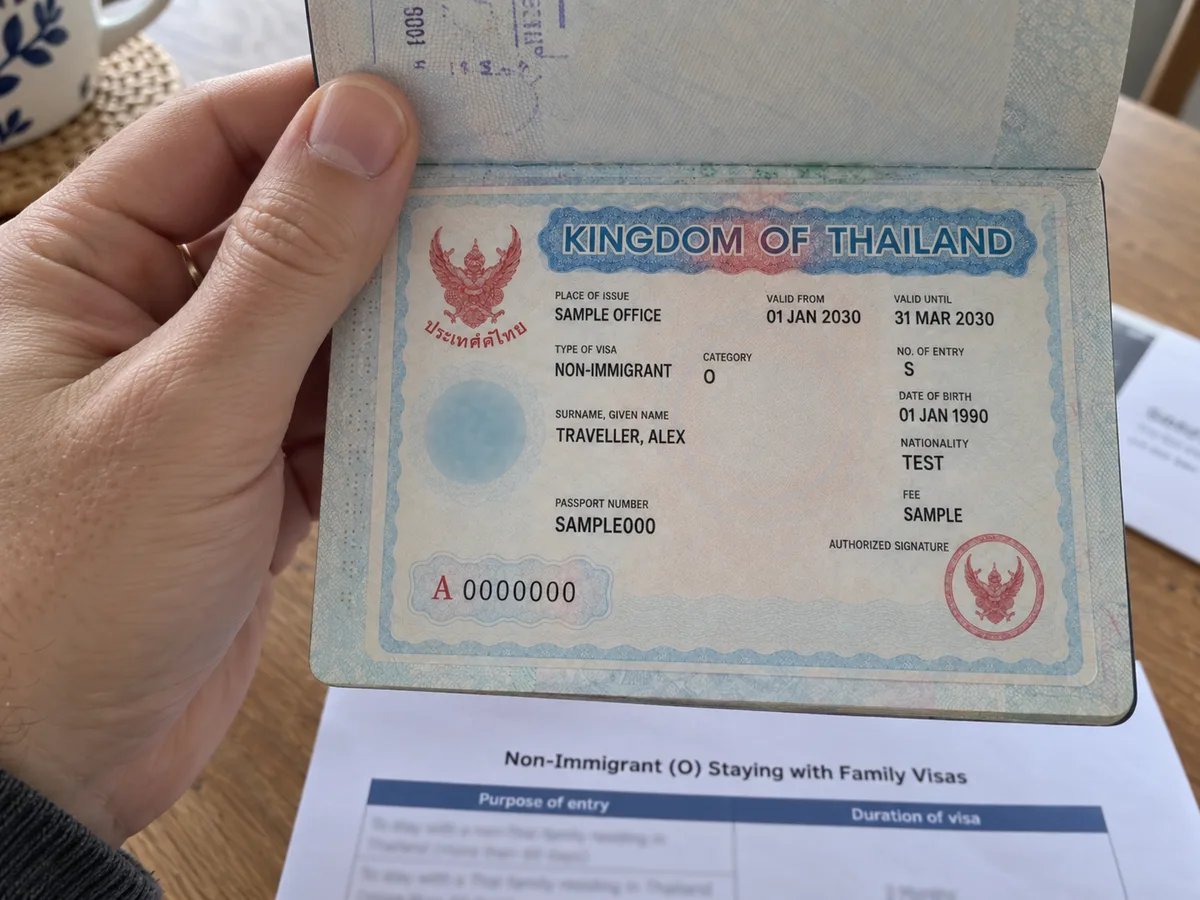
The “O” stands for “Other”, which says a lot. The Non-O visa for marriage, a Thai child, dependants and retirement: the money, paperwork and extensions.
The Non-Immigrant O visa (Non-O for short) is the visa for people who want to live in Thailand because of family: you're married to a Thai, you have a Thai child, you're joining a spouse or parent who works or studies here, or you're 50 or over and retiring. The "O" stands for "Other", which tells you everything about how Thai immigration sorts things. The name is vague, but the requirements aren't, and if you get them wrong you start over.
You start with a 90-day Non-O, either from a Thai embassy or by converting inside Thailand, then apply for a one-year extension at immigration before the 90 days run out.
Who it's for
The Non-O covers several situations, and each one has its own money and paperwork rules.
Marriage to a Thai national - The most common Non-O. You have to be legally married, with the marriage registered in Thailand or recognised under Thai law. A wedding ceremony abroad isn't enough without the legal paperwork.
Parent of a Thai child - You have a child with Thai nationality, whether or not you're married to the Thai parent. You'll need the child's birth certificate showing you as the parent.
Joining family - Your spouse or parent holds a Non-B (work) or Non-ED (education) visa, and you're joining them in Thailand as a dependant.
Retirement - You're 50 or over. It's a Non-O when you apply inside Thailand, or a Non-O-A (Long Stay) when you apply at a Thai embassy abroad.
Other family support - In some cases you can qualify if you're supporting elderly Thai parents or other immediate family.
How much money you need
The amount depends on why you're here:
| Visa type | Bank deposit | OR monthly income |
|---|---|---|
| Marriage (Non-O) | 400,000 THB | 40,000 THB |
| Retirement (Non-O/O-A) | 800,000 THB | 65,000 THB |
| Dependent | Varies | N/A |
Marriage - The 400,000 baht (about $11,100) has to be in your Thai bank account for 2 months before your first extension application, and 3 months before renewal applications. Once the extension is granted you can withdraw it, as long as you put it back before the next renewal. Depositing the money a week before your appointment won't work.
Retirement - The 800,000 baht has to be in a Thai account for at least 2 months before you apply and stay there for 3 months after approval. After that you can withdraw down to 400,000 baht, but no lower, so you can't empty the account like you can on marriage. It needs to be back at 800,000 baht 2 months before your next renewal. Immigration can check your balance at any time, and if it drops below the threshold your extension could be revoked.
Getting a Non-O marriage visa
This is what most people mean by a "Thai marriage visa". You can apply at a Thai embassy in your home country, or convert from a tourist visa inside Thailand (see below). You'll need:
- a passport valid for at least 6 months
- the completed visa application form
- recent passport photos (4x6 cm)
- your marriage certificate (original and copy)
- your Thai spouse's ID card and house registration (tabien baan)
- evidence the relationship is genuine (photos together, correspondence and so on)
- a bank statement showing 400,000 baht or the equivalent for the past 3 months
- a flight itinerary
The visa fee is 2,000 baht for a single entry, or around 5,000 baht for a multiple entry depending on the embassy. It gives you 90 days in Thailand.
Same-sex couples apply on the same terms. Thailand's Marriage Equality Act passed in 2024, so same-sex marriages are legally recognised. If you married abroad, you may need to register your marriage in Thailand first.
Extending for a year on marriage
The one-year extension needs two things: the money and proof your relationship is genuine. For the money, you show either the 400,000 baht in a Thai account (see above) or a monthly income of at least 40,000 baht (about $1,100), verified by your embassy or employer.
Take these to immigration:
- the TM.7 application form
- your passport with your current Non-O visa
- your marriage certificate (original)
- your Thai spouse's ID card and house registration
- your bank statement or income verification
- photos of you and your spouse together at home
- a map to where you live
- proof of address (lease agreement, utility bills)
The fee is 1,900 baht. Thai immigration loves photocopies (seriously, bring a folder full of them), so keep copies of every document, stamp and receipt.
Immigration may also visit your home to check you really live together. They're looking for joint photos, shared belongings, that sort of thing. The visit is usually announced, but not always, and it's not as intimidating as it sounds.
Retiring on a Non-O
If you're 50 or older, you can either get a Non-O-A (Long Stay) from a Thai embassy before you come, or apply for a retirement extension at immigration once you're here. Our dedicated retirement visa guide has the full details. This is the short version.
Non-O-A, applied abroad - You can only get it at a Thai embassy abroad, and the paperwork is stricter. You need:
- to be 50 or over
- no criminal record, and no intention to work in Thailand
- 800,000 baht (about $22,200) in a bank account, OR a monthly income of 65,000 baht (about $1,800), OR a combination totalling 800,000 baht
- health insurance with at least USD 100,000 of cover
- a medical certificate showing no prohibited diseases
- a criminal background check from your home country
The visa fee is 5,000 baht for a multiple entry. It gives you one year in Thailand from your first entry, and you extend it every year at immigration.
Retirement extension, applied inside Thailand - If you're already in Thailand on a tourist visa or another Non-O, you can apply at immigration without leaving the country. You need to be 50 or over with 800,000 baht in a Thai bank account for at least 2 months before you apply. There's no health insurance requirement, which is the big difference from the O-A.
Dependant visa
If your spouse or parent holds a Non-B (work) visa or is studying on a Non-ED (education) visa, you can get a Non-O to join them. You'll need:
- proof of relationship (marriage certificate, birth certificate)
- a copy of their passport and visa
- a copy of their work permit, if they're working
- a school enrolment letter, if they're studying
- evidence of financial support
You can stay as long as their status remains valid. If their work permit gets cancelled or they finish their studies, your dependant status ends too.
Converting to a Non-O inside Thailand
You don't have to fly home to get a Non-O. If you're in Thailand on a tourist visa or a visa-exempt entry stamp (the 30-day stamp you get on arrival), you can convert at immigration. You need more than 15 days left on your current stay and all the standard documents for your Non-O category. It's form TM.86 if you're on a tourist visa, or TM.87 if you came in visa-exempt.
You can do it at the Immigration Bureau in Bangkok (Chaeng Watthana) or at a provincial immigration office. It costs 2,000 baht and takes 1-3 weeks. You get a 90-day Non-O stamp, then apply for the one-year extension before that runs out.
Can you work on a Non-O?
It depends which one you have.
Marriage - Yes, with a work permit. Your employer still has to meet the standard requirements (capital, ratio of Thai employees), and the job can't be on the prohibited occupations list, but the marriage visa itself doesn't stop you working. If you're planning to work, it's the more flexible option, assuming you qualify.
Retirement - Absolutely not. The retirement visa explicitly prohibits all employment, and getting caught working can mean deportation and a re-entry ban. Don't even think about it.
Dependant - Generally no. If you want to work in Thailand you'll need your own Non-B visa and work permit.
90-day reporting
Once you're on any long-term Non-O, you have to report your address to Thai immigration every 90 days. It's a legal requirement. You can report:
- in person at any immigration office
- online at tm47.immigration.go.th
- by registered mail (send it at least 15 days before it's due)
You'll need the TM.47 form, a copy of your passport (photo page, visa page and last entry stamp) and your previous 90-day report receipt, if you have one. Missing a report is a 2,000 baht fine, and several missed reports can complicate your extensions, so set a calendar reminder.
The online system works reasonably well now, though it goes down more often than you'd hope. If you're in Bangkok or a major city, doing it in person is usually faster than dealing with Thailand Post. If you leave Thailand before a report is due, the counter resets when you come back, so frequent travellers may never need to do one.
Re-entry permits
If you leave Thailand without a re-entry permit, your visa extension is cancelled straight away. You'd have to start the whole process again, either at a Thai embassy abroad or by coming back on a tourist visa and converting. Get one before every trip, even a weekend in Singapore.
You can get one at any Thai immigration office or at the immigration counters at international airports. It's 1,000 baht for a single re-entry or 3,800 baht for multiple. The multiple permit lasts as long as your current extension, and if you travel abroad 4 or more times a year it pays for itself. At the airport it takes about 10 minutes, but get there at least an hour before your flight, because queues build up at peak times.
What it costs
These are the government fees for a Non-O marriage or retirement visa:
| Item | Cost |
|---|---|
| Initial Non-O visa (single entry) | 2,000 THB (~$55) |
| Initial Non-O visa (multiple entry) | 5,000 THB (~$140) |
| One-year extension | 1,900 THB (~$53) |
| Re-entry permit (single) | 1,000 THB (~$28) |
| Re-entry permit (multiple) | 3,800 THB (~$105) |
| 90-day report late fee | 2,000 THB (~$55) |
| Tourist to Non-O conversion | 2,000 THB (~$55) |
Budget around 5,000-10,000 baht for your first year of government fees, depending on whether you need to convert and how often you travel.
If you're not sure the Non-O is the right visa for you, the visa overview page compares the options and our other visa guides cover the rest.