Thailand Non-B visa: Complete work visa guide
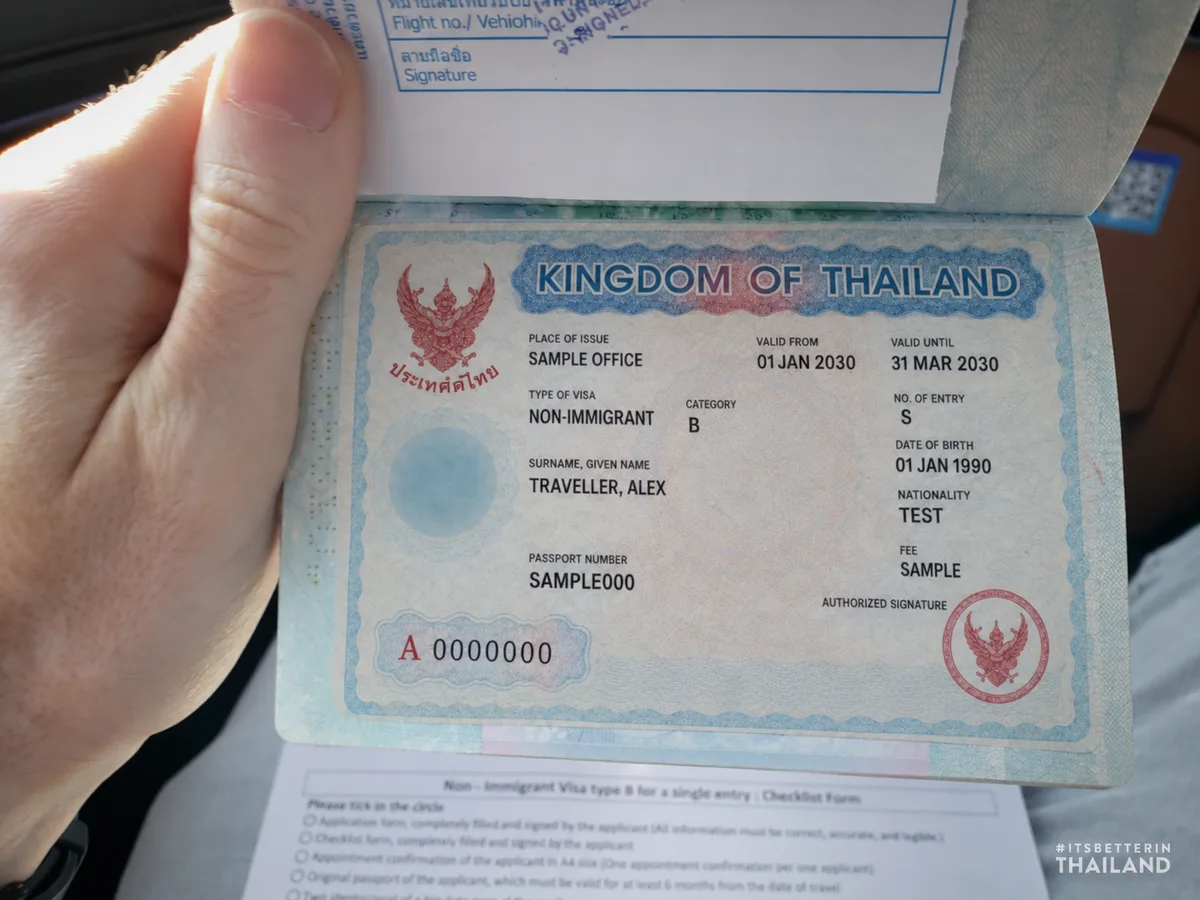
The Non-B doesn’t give you the right to work: that’s a separate work permit. What your employer needs, the papers, costs and steps from job offer to permit.
The Non-Immigrant B visa (usually called the Non-B) is the visa you need to work legally in Thailand. On its own it doesn't give you the right to work, though. It gets you into Thailand for 90 days. You still need a separate work permit, and then you extend your stay every year. Your employer has to meet a few requirements before any of it can start.
Who needs a Non-B visa?
You need one to work for a Thai company or a company registered in Thailand. That covers employees of Thai companies or foreign companies with Thai offices, English teachers at schools and language centres, executives transferred here by their company, and business owners running a registered Thai company.
It isn't for freelancers, remote workers or digital nomads working for foreign companies. If you work remotely for a company outside Thailand, you technically don't need a Non-B, and the DTV visa is the one to look at. Our other visa guides cover the rest.
What your employer needs
You need a job offer first. You can't apply for a Non-B speculatively, because a Thai company has to agree to sponsor you.
The company needs 2 million THB (~$61,500) in registered capital for each foreign employee, or 1 million THB if you're married to a Thai national, and the capital has to be fully paid up, not just registered on paper. It also needs at least 4 Thai employees for every foreign one.
Step 1: your employer gets the WP.32 approval
Before you can apply for the visa, your employer needs pre-approval from the Department of Employment. This is the WP.32 form, basically a letter saying "yes, this company is allowed to hire this foreigner." Your employer submits:
- company registration documents (DBD, shareholders list, VAT certificate)
- company financial statements and tax filings
- a map showing where the office is
- a list of current employees, Thai and foreign
- details of the job they're hiring you for
- your qualifications (degree certificates, work experience letters)
It takes 7-14 working days, sometimes longer if the Department is being particularly thorough. Once it's approved, your employer sends you the WP.32 letter and you can apply for your visa at the Thai embassy in your home country.
Step 2: apply for the Non-B visa
With the WP.32 letter, you apply through the Thai e-Visa system at thaievisa.go.th. Paper applications are no longer accepted. You'll need:
- a passport valid for at least 6 months
- a recent passport photo (4×6 cm)
- the completed e-Visa application form
- the WP.32 approval letter
- an invitation letter from your employer
- proof of qualifications (degree certificate, transcripts)
- evidence of funds (20,000 THB per person, 40,000 THB per family)
- company documents, if they're requested
Some embassies want your degree apostilled or legalised by your home country's foreign affairs ministry before they'll accept it, so find out what yours needs before you leave home.
A single entry Non-B visa costs 2,000 THB and is valid for 90 days. A multiple entry costs 5,000 THB and is valid for a year. It takes 5-10 business days, and once it's approved you can enter Thailand and stay for up to 90 days.
Step 3: get your work permit
This is where a lot of people mess up. Having a Non-B visa doesn't mean you can start working. You have to get a work permit within 90 days of arriving, and working without one is illegal, even with a valid Non-B. It can get you fined, deported and banned from coming back.
The application goes in online through the e-WorkPermit system first, then you go to the Department of Employment (or the One Stop Service Centre in Bangkok, which is marginally less chaotic) for fingerprints and your work permit card. Your employer will handle most of it, but you'll need to show up in person with:
- your passport with the Non-B visa
- 3 passport photos (3×4 cm)
- a medical certificate from a Thai hospital
- copies of your degree certificates and transcripts
- copies of your employment contract
- a power of attorney for your employer to act on your behalf
The work permit costs 3,000 THB for one year. Once it's issued you can legally work.
Step 4: extend your visa every year
The one-year extension is done at Thai Immigration, before your 90 days are up. You'll need:
- the TM.7 application form
- your passport
- your work permit
- recent passport photos
- copies of company documents (your employer provides these)
- your employment contract and salary details
- your personal income tax filing (Por Ngor Dor 91)
The extension costs 1,900 THB. Immigration also asks for your tax identification number (TIN), and working here means you'll owe Thai income tax. You'll need a Thai bank account for your salary too, and some extensions require one (opening one is easier than you'd expect).
You can keep extending every year as long as you're employed and your work permit is valid. After three years of continuous work in Thailand you can apply for permanent residency, though that's a whole separate process.
How long it takes
Start early. From job offer to approved visa is at least 3-4 weeks, and with travel and another week or two for the work permit, you're looking at 4-6 weeks minimum before you're legally working. Don't tell your new employer you can start next Monday.
Keep several copies of every document, plus scans, because you'll be asked for them again and again. Thai bureaucracy loves photocopies.
Converting a tourist visa to a Non-B inside Thailand
You don't always have to fly home. If you're in Thailand on a Tourist Visa or a visa-exempt entry (the 30-day stamp you get on arrival) with at least 15 days left, you can convert to a Non-B at Thai Immigration. Other visa types, like a Non-O, can't be converted. Your employer needs the same documents ready as for a fresh application.
You apply on Form TM.86, or TM.87 if you came in visa-exempt, at the main Immigration office in Bangkok (Government Complex, Chaeng Watthana) or a provincial office. It costs 2,000 THB and takes about 15 days, and you have to stay in Thailand while it's processed. You get a 90-day Non-B stamp, the same as if you'd applied abroad, then do the work permit as normal.
Conversion is at the immigration officer's discretion, so if you're planning to work here, it's generally cleaner to get the Non-B from abroad.
What jobs are off-limits to foreigners?
Thailand reserves about 40 occupations for Thai nationals, and even with a valid Non-B visa and work permit you can't legally work in them. The list includes manual labour and construction, tour guides, taxi and tuk-tuk drivers, hairdressers and beauticians, street vendors, Thai massage therapists, silk weavers, nielloware and lacquerware craftspeople, gem cutters, secretaries, and most agricultural work.
Some professions like accounting, architecture and engineering are allowed only if you hold Thai professional registration or work under an international agreement (like the ASEAN mutual recognition arrangements).
If you're not sure your job is allowed, ask the Department of Employment before you accept the offer. Getting this wrong means no work permit, and your employer won't be happy either.
How much it costs
These are the government fees:
| Item | Cost |
|---|---|
| Non-B visa (single entry) | 2,000 THB (~$62) |
| Non-B visa (multiple entry) | 5,000 THB (~$154) |
| Work permit (1 year) | 3,000 THB (~$92) |
| Annual visa extension | 1,900 THB (~$58) |
| Re-entry permit (single) | 1,000 THB (~$31) |
| Re-entry permit (multiple) | 3,800 THB (~$117) |
| Tourist to Non-B conversion | 2,000 THB (~$62) |
For your first year that's around 7,000-10,000 THB in government fees, depending on whether you get single or multiple entry, and around 10,000-15,000 THB for all fees. Your employer may also charge you for their admin costs or have you pay for the medical certificate and document translations, so budget 15,000-20,000 THB in total to be safe.
90-day reports and re-entry permits
Once you're on a Non-B with a work permit, you have to report your address to Immigration every 90 days (yes, every 90 days, forever, until you leave or get permanent residency). It's separate from your yearly extension. You can do it in person at any Immigration office, online through the Immigration 90-day report system, or by post, sent 15 days before it's due. Miss a report and it's a 2,000 THB fine, and missing several can complicate your extensions.
Your extension is tied to your stay in Thailand. Leave the country without a re-entry permit and your visa is cancelled, and you'd have to start the whole process again. Get one at the airport Immigration counter or any Immigration office before you travel. A single re-entry is 1,000 THB, and a multiple re-entry is 3,800 THB and covers you for the rest of your visa. If you travel a lot, the multiple one pays for itself after four trips.
What happens if you lose your job?
If your job ends, whether you quit or get fired, your work permit becomes invalid immediately. You have about 7 days to find a new employer who will transfer your work permit, change to a different visa type, or leave Thailand.
You can change employers on a Non-B, but you need to transfer your work permit to the new employer before your current one expires. If there's a gap between jobs, you'll need to either extend your stay on a different visa type or leave the country and come back on a new Non-B from the new employer.
Don't overstay. If your work permit is cancelled and you don't sort out your visa, you're in Thailand illegally. Overstay fines are 500 THB per day, and serious overstays can get you banned from re-entering Thailand for years.