How to open a Thai bank account as a foreigner
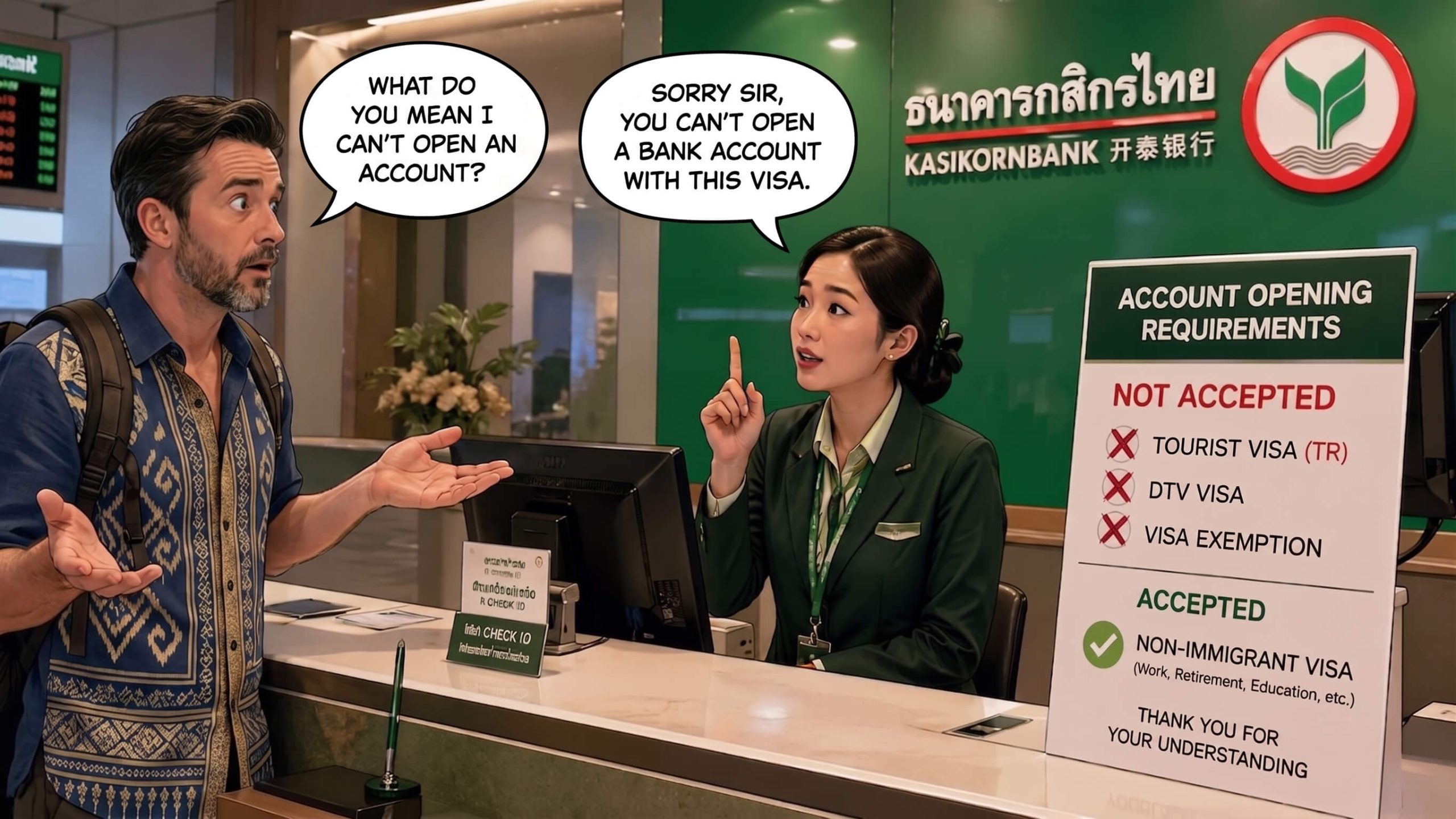
The TLDR on this is that if you do not hold a long term visa, opening a bank account is very difficult, and not worth the time trying. Also, unfortunately even though the DTV seems like a long term visa, it’s classed as a tourist visa and as of now, you will not be able to open a new account on the DTV visa.
Why a Thai bank account?
A local bank account in makes life in Thailand a lot more convenient. Similar to how in China everything is running through Alipay and WeChat, Thailand is running on PromptPay QR payments. However unlike China, cash is still pretty common here and for the most part you’ll have no problem (unless you try to pay everything with 1000 baht notes, try to break these in to smaller notes when possible, for example at 7 Eleven.
ATM fees
The other big draw is ridding yourself of ATM fees. ATMs still cost 200+ THB per withdrawal, so you end up taking out the maximum amount and then you’re carrying almost 1000 USD everywhere just to try and save on ATM fees. The best way to save on ATM fees is using Wise (see below).
There are supposedly a few things in the pipeline to help tourists pay by QR codes, but for one-off trips and holidays it’s just not worth trying to open an account.
Transferring through Wise
Receiving money from abroad through Wise into a Thai bank account costs less than at airport exchanges or international bank transfers due mid-market exchange rates and low fees.
Bills and payments
If you’re working in Thailand, paying rent, utilities, tax returns, etc, it’s all built in to Thai banking apps - otherwise it’s just a pain going to do it all in person.
The visa situation (this has changed)
The big issue is your visa.
Since mid 2025, banks have been on a crackdown driven by a government push to shut down money mule accounts used in online fraud. Over 3 million accounts had been suspended by September 2025. The damage: banks now reject almost all short-term visa holders, and Bangkok Bank even started closing existing accounts held by foreigners without long-term visas.
Visas that work:
- Non-immigrant B visa (work)
- Non-immigrant O visa (retirement, marriage, family)
- Non-immigrant ED visa (education) - varies by bank; Krungsri only accepts university or international school enrollment
- Long-Term Resident (LTR) visa
- Thailand Privilege visa (formerly Elite) - members get a concierge letter that makes the process smooth
Visas that don’t work:
- Tourist visa (30/60 days)
- Visa exemption stamps
- Visa on arrival
- Destination Thailand Visa (DTV) - banks now classify this as a tourist-category visa and reject it
If you’re on a tourist visa and planning to stay long-term, sort out your visa situation first. The bank account comes after.
Which bank to choose
Not all Thai banks treat foreigners equally. Some are welcoming; others will send you away.
Bangkok Bank
Bangkok Bank has historically been the most foreigner-friendly bank, but they tightened significantly in January 2026. They now require a long-term visa and stopped accepting DTV holders entirely. In May 2025, they began closing accounts of foreigners without long-term visas. That said, they still have English-speaking staff at major branches and are more flexible on documentation than others.
The other upside: Bangkok Bank has a branch in New York, which makes international wire transfers and receiving US Social Security payments simpler if that applies to you.
Kasikorn Bank (KBank)
Kasikorn’s K PLUS app is the best of them all, in our opinion. They’re stricter than Bangkok Bank on visa requirements. Not worth trying without correct visa and all paperwork. Known to be difficult on supported visas if there’s no work permit.
Siam Commercial Bank (SCB)
SCB is Thailand’s oldest bank (founded 1907) and has excellent ATM coverage. But they’re the strictest about foreigner requirements - almost always requiring a work permit.
Krungsri (Bank of Ayudhya)
In 2024, Krungsri stopped opening accounts for tourist visa, visa-exempt, DTV, and most ED visa holders (they’ll only accept ED visas from universities or international schools). They also require a 20,000 baht average balance to avoid a 100 baht monthly fee, which is significantly higher than other banks.
Our recommendation
Start with Bangkok Bank or Kasikorn. If one branch rejects you, try another - there’s significant variation between branches. Large branches in expat-heavy areas (Sukhumvit in Bangkok, Nimman in Chiang Mai, Walking Street area in Pattaya) are used to dealing with foreigners and know what’s possible.
Documents you’ll need
Bring photocopies of everything.
Absolutely required
- Passport - original plus photocopies of the photo page, visa page, and most recent entry stamp
- Valid visa - non-immigrant or long-term (see visa section above)
- Thai phone number - for SMS verification and mobile banking. Important: the SIM must be registered in your name (matching your bank account name). Buy a SIM at any 7-Eleven and make sure to register it with your passport.
- Initial deposit - 0-2,000 THB in cash
Proof of address (bring at least one)
This is where people get stuck. You need to prove you actually live in Thailand.
Best option: Certificate of Residence from Thai Immigration
This is a must if you do not have a work permit. Most banks accept it without question. To get one:
- Your landlord must have filed your TM30 (arrival notification) - this is mandatory and often forgotten
- Go to your local immigration office with your passport, TM30 receipt, photos, and the application form
- Pay about 200 baht
- Wait same-day to several business days (or weeks) depending on the office
Additional options:
- Rental contract or lease agreement
- Utility bill in your name (electricity, water, internet)
- Bank statement from a home country bank showing Thai address
- Letter from your embassy certifying residence (alternative to the certificate of residence above)
If you’re staying in a hotel or Airbnb, this gets difficult. The Certificate of Residence is really your only option, and you’ll need the hotel/landlord to file the TM30 first.
Supporting documents (if you have them)
These aren’t always required but help your application:
- Work permit - makes approval nearly guaranteed at any bank
- Employer letter - confirming your employment and salary
- Reference letter from home bank - proving you’re a legitimate account holder somewhere
- School enrollment letter - if on an ED visa
The step-by-step process
1. Get a Thai phone number first
Before you even walk into a bank, get a Thai SIM card. Banks require a local number for two-factor authentication, SMS alerts, and mobile banking activation.
Walk into any 7-Eleven, ask for a SIM card, show your passport, and they’ll set it up. We use TrueMove. A 30-day data package costs about 300 baht. Takes five minutes.
2. Choose your bank and branch
Pick Bangkok Bank or Kasikorn. Find a large branch - shopping mall branches or main branches in major cities are best. These have English-speaking staff and are experienced with foreigner applications.
Call ahead if you can. Ask specifically: “I’m a foreigner with a [your visa type] visa. Can I open a savings account at this branch? What documents do I need?”. Even better if a Thai friend can call them for you.
3. Show up early
Banks open between 8:30 and 9:00 AM. Get there when they open. Lines grow fast, especially on Mondays and after lunch. Most banks stop accepting new account applications about an hour before closing time. Opening times and days can be different (closing later for example) in shopping malls.
4. Bring everything
Documents to have with you:
- Passport (original)
- All passport photocopies
- Proof of address
- Supporting documents
- Thai phone number (written down)
- Initial deposit in cash
- A pen
Dress reasonably - you don’t need a suit, but don’t show up in beach clothes. First impressions matter in Thai bureaucracy.
5. Fill out the forms
The staff will give you an application form. They may ask about your source of income and purpose of the account, and request supporting documents. Give accurate answers that reflect how you will actually use the account.
The Bank of Thailand says you can choose a card without insurance, or decline a card altogether. If you feel pressured to take an insurance-linked card, you can complain to the bank’s call centre.
6. Get your debit card and bank book
Most banks issue a debit card immediately. You’ll set a PIN at the counter. The card works at ATMs and anywhere that accepts Thai debit cards. PromptPay registration links your bank account to an ID or phone number; ask the bank how to register your account.
Some branches may take 1-2 weeks to issue the physical card and give you a temporary slip instead.
You’ll also walk out with a “bank book” - a little physical passbook with your account number, branch info, and SWIFT code printed inside. Yes, in 2026. Thai banks still hand them out and you’ll want to keep yours somewhere safe.
You’ll need the bank book for some in-branch transactions, when you eventually close the account, and as the easiest place to find your SWIFT code when receiving money from abroad. You can take it to any branch to “update” it - they print recent transactions inside, a bit like a long receipt. Most people only bother updating this when they need a paper record for visa applications, tax filings, or embassy paperwork.
7. Set up mobile banking before you leave
Don’t skip this. Ask the staff to help you download the bank’s app and activate it before you walk out. Sometimes it has to be done using an ATM and it’s a bit of a headache.
After you have the account
How to receive international transfers
This is probably why you wanted the account in the first place. To receive money from abroad:
- Get your account details from the mobile app or bankbook (account number, bank name, branch name, SWIFT code)
- Use Wise to transfer from your home currency to THB
- Wise deposits directly to your Thai bank account, usually within 24 hours
Wise uses the real mid-market exchange rate with transparent fees, typically 0.5-1% for most currencies. Bank-to-bank wire transfers can’t compete.
One thing to know: Wise transfers are processed through Thai banking partners locally, so they don’t always register as “foreign remittance” in the traditional sense. If you need official documentation of international transfers for a retirement or marriage visa, you may need to use traditional bank wires occasionally. See our retirement visa guide for details.
PromptPay - how Thailand actually works
Once your account is set up with PromptPay, you’ll understand why it’s worth the hassle. Scan a QR code, confirm the amount, done. Accepted at:
- Every 7-Eleven and convenience store
- Most restaurants and cafes
- Street food vendors (increasingly)
- Grab and Bolt
- Utility payments
- Rent payments
Transfers between any Thai bank accounts via PromptPay are instant and free.
ATM tips
- Own bank ATMs: Free withdrawals, no fees
- Other bank ATMs: About 10-20 baht per withdrawal (some accounts give you a few free each month)
- Out-of-province ATMs: No extra charge at your own bank’s ATMs any more
- Withdrawal limits: 20,000-30,000 baht per transaction, depending on the ATM
Common problems and how to fix them
“We can’t open an account for tourists”
Your visa doesn’t qualify. Upgrade your visa - additional documentation (TM30, embassy letter) no longer gets tourists an account, even at Bangkok Bank branches in expat-heavy areas.
“You need a work permit”
Try Kasikorn or Bangkok Bank instead of SCB. Or return with additional documentation - a Certificate of Residence from Immigration often satisfies this requirement even without a work permit.
“You need proof of address”
Get a Certificate of Residence from Thai Immigration. It takes a few days but solves this problem. Make sure your TM30 is filed first.
“This branch can’t help you”
Branch discretion is real. The manager has significant latitude. If one branch says no, try another - preferably a larger one in an expat-heavy area.
What if you can’t get a Thai bank account?
If your visa doesn’t qualify and you’re not ready to upgrade, you have options:
Wise - You can hold Thai baht in a Wise account and transfer money cheaply. But you won’t be able to receive Thai salary payments, and PromptPay only works if your Wise account is registered to a Thai address.
Withdraw cash strategically - If you’re stuck using foreign cards, withdraw larger amounts less frequently to minimize per-transaction fees. Keep the cash secure.
Check back later - Rules evolve. If you’re planning to stay long-term, a non-immigrant visa may be your path to banking access.
FAQ
Can I open a Thai bank account on a tourist visa?
Not anymore. As of 2025, most Thai banks reject tourist visa holders. You’ll need a non-immigrant visa (B, O, ED), a long-term visa like the LTR, or a Thailand Privilege visa to open an account.
Which Thai bank is best for foreigners?
Bangkok Bank and Kasikorn Bank (KBank) are the most foreigner-friendly. Bangkok Bank is more lenient with documentation, while Kasikorn has a better mobile app. Start with one of these.
How much money do I need to open a Thai bank account?
Most banks require an initial deposit of up to 500 THB. Apart from Krungsri, there’s no requirement to maintain a large balance after opening.
Can I use Wise instead of a Thai bank account?
Wise is excellent for transferring money to Thailand, but it can’t fully replace a local bank account. You won’t be able to receive Thai salary payments or make local payments as easily, and PromptPay only works if your Wise account is registered to a Thai address. Use both - Wise for transfers in, Thai bank account for everything else.
Do I need a work permit to open a Thai bank account?
Not necessarily. A work permit makes approval easier, but you can open an account with other long-term visas if you have proper documentation like a Certificate of Residence.
How long does it take to open a Thai bank account?
If you have all documents ready, the process takes about an hour at the branch. The debit card is usually issued same-day. Getting a Certificate of Residence beforehand (if needed) takes a few extra days.
Can I open multiple Thai bank accounts?
Yes. There’s no rule against having accounts at multiple banks. Some expats keep a Bangkok Bank account for international transfers and a Kasikorn account for better mobile banking.