Thailand retirement visa: Guide to retirement in Thailand
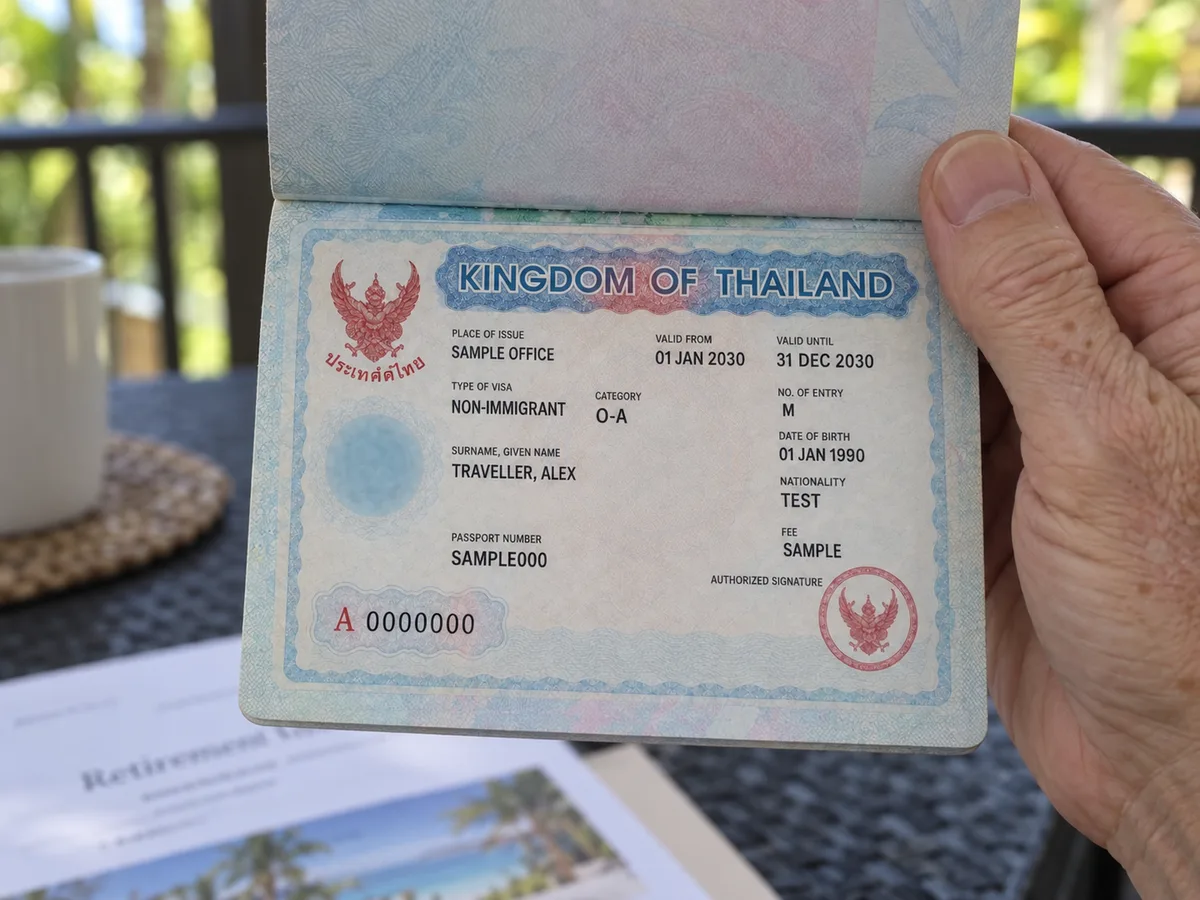
No language test, no property, no minimum stay: at 50 with 800,000 baht or 65,000 a month, you can retire here. O-A, O-X and Non-O, money and insurance.
If you're 50 or over and want to retire in Thailand, the retirement visa is the most straightforward way to live here long term. You need to show the money, have no criminal record and have health insurance from an approved provider. There's no language test, no property requirement and no minimum stay. You can't work on it, and that includes online work, which is technically illegal too.
There are three versions: the O-A, which you get before you come and lasts a year; the newer O-X, which lasts 5-10 years; and the basic Non-O visa, which you get inside Thailand and turn into a retirement extension. Most people go with the O-A.
How much money you need
There are three ways to show it.
Money in the bank - 800,000 baht (about $24,000) in a Thai account, deposited at least 2 months before you apply and kept there for 3 months after you get the visa. It can then drop to 400,000 baht, but has to be back at 800,000 two months before you renew. Immigration does check.
Monthly income - 65,000 baht a month (about $1,900) in pension or other regular income from outside Thailand, with an affidavit from your embassy or consulate.
A mix of both - Savings plus annual income adding up to 800,000 baht, for example 400,000 in the bank and 400,000 of income.
The money in your Thai account has to come from abroad. Immigration wants to see international transfer codes in your bank book, and domestic transfers don't count.
Health insurance
Health insurance has been compulsory for the O-A since 2019: at least 3,000,000 baht of cover from an approved Thai insurer (the list is at longstay.tgia.org). An international policy works for the visa application if the insurer signs the embassy's certificate, but extensions in Thailand need a Thai policy from that list. Let it lapse and your renewal fails.
If you convert inside Thailand instead (below), there's no insurance requirement. We'd still get insured, because being uninsured here is risky.
Applying from home: the O-A visa
This is the traditional route. There's more paperwork, but you arrive with everything sorted and a visa for a year. You apply online at thaievisa.go.th and approval takes 2-4 weeks.
You'll need:
- a passport with at least 18 months left on it
- the online application form, with your passport photo uploaded
- a criminal background check from your home country, less than 3 months old
- a medical certificate saying you don't have any prohibited diseases, less than 3 months old
- proof of your money (bank statements or pension letters)
- a health insurance policy from an approved provider
Get the criminal check and medical certificate first, then arrange the Thai health insurance, then apply.
Converting inside Thailand
This is the most popular route. You don't need a criminal check, a medical certificate or insurance, but there are more steps once you're here. This is how most people do it:
- Month 1: Arrive on a 60-day tourist visa.
- Weeks 1-2: Find somewhere to live and get a lease agreement.
- Weeks 2-3: Open a bank account (use an agent if you need to).
- Week 3: Transfer the 800,000 baht from your home country.
- Month 2: Leave the money to "season" for 2 months and explore Thailand.
- Day 45-50: Extend your tourist visa for 30 days (1,900 baht).
- Month 3: Apply for a 90-day Non-O visa at immigration.
- Months 4-5: Wait on the Non-O.
- Months 5-6: Before the 90 days run out, apply for the 1-year retirement extension.
That gives you retirement status for a year.
You can start on a visa exemption instead, but that's only 30 days plus one 30-day extension, and you need at least 15-21 days left on your stamp to convert, depending on the immigration office.
The O-X visa
The O-X is for people with more money who want longer. You get a 5-year stamp each time you enter, can extend once to 10 years in total, and there are no annual extensions. It's only open to citizens of 14 countries, including the US, UK, Canada, Australia, Japan and some European countries.
You need:
- 3 million baht in a Thai bank, OR 1.8 million in the bank plus 1.2 million a year in income
- Thai health insurance covering 40,000 baht outpatient and 400,000 baht inpatient
Honestly, unless you really hate dealing with immigration, the standard O-A is better value for most people.
Opening a Thai bank account
This has become the biggest challenge for retirees, so start on it as soon as you arrive. Bangkok Bank and Kasikorn are still the most foreigner-friendly. Take a Thai speaker if you can, and if one branch says no, try another, because policies vary. A lease agreement helps, and some banks want you to buy one of their insurance products. An agent can do it for 5,000-30,000 baht and guarantees you'll get the account.
Using a visa agent
Agents are a bit controversial. They can open the bank account, do the paperwork and deal with immigration for you, and some will get you around requirements, which is legally questionable. Expect to pay 15,000-50,000 baht a year, use a reputable one, and remember you're still responsible if anything goes wrong. For your first year, while you learn the process, one can save you a lot of headaches.
Every year after that
Three things keep the visa alive once you have it.
The annual extension - Apply 30-45 days before it expires, with your updated bank books and statements. The money rules are the same and the fee is 1,900 baht.
90-day reports - Every 90 days you have to report your address to immigration, in person, online (when it works), by registered mail or through an agent. Miss one and the fine is up to 5,000 baht, so put it in your calendar.
Re-entry permits - Leave Thailand without a re-entry permit and your visa is cancelled, even after one trip. It's 1,000 baht for a single re-entry or 3,800 for multiple (worth it if you travel often), from immigration or the airport before you leave.
Keep copies of all your documents and photograph every immigration stamp. It also helps to get to know your local immigration office, because officers interpret the rules differently and what worked last year might not work this year. Expat groups are good for current information, but don't trust Facebook advice blindly.
Tax
If you stay 180 days or more in a year you're a Thai tax resident, and Thailand is enforcing this more strictly. Foreign income you bring in may be taxable, depending on the tax treaty with your home country. The rules are changing, so talk to a tax professional.
Where to retire in Thailand
These are the popular places to retire.
Bangkok - The best healthcare and the most conveniences, but polluted and expensive.
Chiang Mai - A cool season, mountain views and a large expat community, but the burning season is rough.
Hua Hin - A beach town with royal connections, quieter than Pattaya, with good hospitals.
Pattaya - You'll love it or hate it. Huge expat infrastructure, great hospitals and an active nightlife.
Phuket - Island life and beaches. Expensive, but beautiful, and there's a good international hospital.
Koh Samui - A smaller, laid-back island. It's more expensive and the healthcare is limited.
Retirement visa vs other visas
How the retirement visa compares with the other ways to stay long term:
| Visa type | Age requirement | Financial requirement | Can work? |
|---|---|---|---|
| Retirement O-A | 50+ | 800,000 THB | No |
| Marriage O | Any | 400,000 THB | With permit |
| Thailand Privilege | Any | 650,000 THB fee | No |
| LTR Pensioner | 50+ | $80,000/year income | No |
If you're not sure retirement is the right route, compare Thailand's other visa routes or see all our visa guides.