The Mae Hong Son Loop - Planning your own itinerary
The Mae Hong Son Loop is a 600 km ride from Chiang Mai through Pai, Mae Hong Son and Mae Sariang and back. It’s also become a backpacker rite of passage, which is annoying, but doesn’t make it any less good.
It has 4,088 curves, and Thailand’s Ministry of Tourism has the honesty to list Route 1095 as one of the country’s most dangerous roads for foreign tourists. Most accidents come from rushing, riding at night, drinking or overestimating your skills. If you can handle a scooter in normal traffic, you can do it: start early, stop often, never ride at night and give yourself more days than you think you need.
The route
The loop is a rough circle through the mountains northwest of Chiang Mai, in four legs:
Chiang Mai to Pai: 130 km (3-4 hours with stops)
Pai to Mae Hong Son: 107 km (3-4 hours)
Mae Hong Son to Mae Sariang: 162 km (4-5 hours)
Mae Sariang to Chiang Mai: 196 km (4-5 hours)
Detours to Ban Rak Thai, Mae Surin Waterfall or Doi Inthanon add 100-200 km. Most people take 4-5 days, but if you actually want to explore and not just tick off photo spots, budget 6-7. You can technically do it in 3, but you’ll spend all your time on the bike.
Clockwise or counterclockwise?
There’s no wrong answer. Counterclockwise, via Pai first, is more popular with first-timers and day one is an easy ride, but you do the hardest section (Pai to Mae Hong Son) when you’re least experienced. Clockwise, the roads get harder as you go and you finish in Pai, a better reward than Mae Sariang.
We’d lean clockwise if you have even basic riding experience. But counterclockwise is fine - just don’t rush the Pai to Mae Hong Son section. The days below run counterclockwise.
Getting a bike
The old city and Nimmanhaemin in Chiang Mai are packed with rental shops. Daily rates are:
- 125cc automatic scooter (Honda Click, Yamaha Mio): 200-350 baht/day
- 160cc scooter (Honda PCX): 500-600 baht/day
- 110-125cc semi-automatic (Honda Wave, Dream): 180-350 baht/day
- 250cc-300cc manual motorbike (Honda CRF, Kawasaki): 800-1,200 baht/day
For 5 days you’ll pay toward the lower end. Ask for the weekly rate even if it isn’t advertised: 7 days on a 125cc should be 1,200-1,800 baht.
Most riders do the loop on a 125cc automatic, usually a Honda Click. It’s fine solo with a small backpack but struggles on steep climbs with a passenger or heavy luggage (Yun Lai and Doi Inthanon will have you at full throttle), so if you’re carrying either, get at least a 150cc. A 125cc semi-automatic like the Honda Wave has more torque on the climbs, no clutch and spare parts in every town. A 250cc+ manual (Honda CRF250, Kawasaki Versys) is for experienced riders, overkill for the main loop, nice for dirt side-trips and roughly 3x the price.
Shops want a 2,000-3,000 baht cash deposit or your passport, and some take a credit card hold. Never leave your actual passport. A photocopy is fine, but if something goes wrong with the bike or the rental shop tries to scam you, you need your passport to leave the country. This isn’t theoretical - it happens.
Disputes over “existing damage” are common, so photograph every scratch and dent (and the odometer) before you ride off and email the photos to yourself. Test the brakes, lights and horn, check the tyres and chain, and ask about roadside assistance.
These three shops have good reputations:
Cat Motors - On Ratchamanka Road in the old city. Decent bikes, fair prices, good about damage disputes. They have CRFs if you want something bigger.
Mango Bikes - In the Nimman area. Popular with loop riders. They know the route and can give advice on road conditions.
Mr. Mechanic - On Moon Muang Road. Good for budget rentals. Older bikes but well-maintained.
You technically need a valid driving licence and an international driving permit (IDP) with a motorcycle endorsement: about $20-30 from your home automobile association (AAA, CAA, etc.) or £5.50 from a UK PayPoint shop. Enforcement is patchy, but police checkpoints on the loop are common, especially around Pai. If you crash without proper documentation, your travel insurance won’t cover you, the police report will list you at fault regardless of what happened, and you’ll be liable for all damage and medical costs. The IDP is worth the $20.
Most basic travel insurance doesn’t cover motorcycles, or only bikes under 125cc, and many policies need a valid licence and a helmet. SafetyWing and World Nomads both cover motorcycles, but read the fine print about licences.
You can also rent a car through Rentalcars.com in Chiang Mai and drive it. You’ll miss the experience of being on a bike, but you’ll also stay dry when it rains.
Fuel and the road
Fill up in each major town (Pai, Mae Hong Son, Khun Yuam, Mae Sariang) and you won’t run out. The gaps are longest between Mae Hong Son and Mae Sariang, so don’t leave town on a quarter tank there.
The roads are paved and decent, but the curves keep some sections to 30-40 km/h. Watch for fog, which rolls in fast up high, especially in the morning and late afternoon, wet roads that are slippery even when they don’t look it, gravel, dogs, livestock, and buses and trucks taking curves wide.
Ride only during daylight. This isn’t negotiable. The roads aren’t lit, visibility drops to nothing when the fog comes, and you don’t want to hit a stray dog at 60 km/h in the dark.
Day 1: Chiang Mai to Pai (130 km)
Leave by 9am, once the fog has burnt off, and head north on Route 107 toward Chiang Dao before turning onto Route 1095. The first hour out of Chiang Mai is flat and boring. Don’t worry, that changes fast.
Mae Malai (km 30ish) - The turnoff onto 1095, with petrol and a few local restaurants. Fill up here. The fried rice at the stalls near the junction is fine - nothing special, just fuel for the ride.
Mok Fa Waterfall (km 55) - Signposted on the left, 100 baht for foreigners and a 10-minute walk from the car park. It’s nice enough in the wet season (big water flow) but a trickle in January/February.
Huai Nam Dang National Park - Worth a night if you have 6-7 days. At around 1,600 metres, its sunrise mist views from Doi Kiew Lom, over the Pai valley to Doi Chiang Dao, are some of the best in northern Thailand (be up by 5:30am). Entry is 300 baht for foreigners, camping 30 baht with your own tent or 225 baht for a park tent, and bungalows 600-1,500 baht.
The 762 curves to Pai - Route 1095 between Mae Malai and Pai has 762 curves. That’s not a joke or an exaggeration - it’s the official count posted on a sign at the Pai end. Take them slowly and stop if you feel sick or tired. Most riders arriving from Chiang Mai describe the last 30 km before Pai as the most intense - tight switchbacks descending into the valley. Stay in your lane, as tour buses come the other way.
Pai
Pai is a valley town you can walk across in 15 minutes. It’s been a backpacker hub since the 1990s and is now thoroughly colonised by Instagram influencers, yoga retreats and acoustic guitar cafes. The walking street is heaving every night, and you’ll hear more English than Thai. It’s still a nice place, just don’t expect authentic hill tribe culture. Stay two nights to get a full day to explore off the bike.
Pai Canyon (free) - A narrow ridge walk with drops on both sides and no guardrails, 8 km south of town. It’s best at sunset, sketchy when wet, and not one for after drinking.
Tha Pai Hot Springs - Genuinely hot springs 7 km south, 300 baht, with a cold stream mixing in. Go in the morning.
Pai Land Split - A crack in the earth from a 2008 seismic event. Sounds boring, but the little stall next to it (run by the farmer whose land split open) is one of the nicest spots in Pai. The farmer charges nothing and just hands out roselle juice and fruit. Leave a tip.
Yun Lai viewpoint - A hilltop Yunnanese village with 360-degree valley views and a tea shop, 20 baht. Go at sunrise. A 125cc with a passenger might struggle on the road up.
Pam Bok waterfall - A small waterfall with a swimming pool, 8 km out, 200 baht. Quiet compared to everything else. Best in the wet season.
Memorial Bridge (Tha Pai WWII bridge) - A steel footbridge on the site of a Japanese-built WWII bridge, 9 km out. It’s a photo stop, but the ride through the paddies is pleasant.
For food, the Walking Street night market (from 5pm) has some of the best cheap eating on the loop: pad thai 40-60 baht, mango sticky rice 50, smoothies 40. The coconut pancakes from the stalls near the bridge are weirdly good.
Na’s Kitchen - Thai food at local prices. Nothing fancy, reliably good. On the main road.
Cafecito - If you need proper coffee that isn’t Nescafe 3-in-1. Also does decent breakfast.
Burger House - For when you want Western food after a week of rice. Actually good burgers, not the sad backpacker-trail kind.
Dorms are 250-500 baht (Common Grounds is popular), garden bungalows by the river or on the Pai Canyon road 500-1,200, and places with actual comfort, like Pai Vimaan Resort or Reverie Siam (which has pools), 2,000-5,000 - worth it if you’ve been on a bike for 5 hours and your back hurts. Book Pai accommodation early from November to February, especially weekends, when Chiang Mai residents come up.
Day 2/3: Pai to Mae Hong Son (107 km)
This is the best section and the most demanding, with blind curves and fog that can drop visibility to 20 metres. It’s only 107 km, but the side trips will use every hour of daylight.
Lod Cave (Tham Lod) - The highlight of the loop for a lot of riders, 8 km off the main road at Soppong (also called Pang Mapha). A river runs through it, past stalactites and wooden coffins up to 2,000 years old. A guide is compulsory: 300 baht for up to 3 people, or 600 baht per group with the bamboo raft, for 1.5-2 hours through three chambers. Arrive around 4pm and you get the tour AND the sunset, when hundreds of thousands of swifts spiral in while the bats spiral out. It’s one of those things that doesn’t translate to video - you need to see it. Soppong has basic guesthouses (300-600 baht), and Cave Lodge, by the cave since 1984, has rooms for 400-1,000 baht.
Staying near the cave - There are basic guesthouses in Soppong (300-600 baht). Cave Lodge, a few hundred metres from the cave entrance, has been running since 1984 and has a loyal following. Rooms 400-1,000 baht.
Baan Ja Bo - A Black Lahu village on a ridge, known for its “sea of clouds” at sunrise. Stay in a basic homestay (from about 300 baht a person, don’t expect much) to see it. There’s a cafe here now, and the village has become more touristy, but at 6am with the mist rolling in, it still feels genuinely remote. The road up is steep and sometimes unpaved.
Baan Rak Thai (Mae Aw) - A Kuomintang village of tea houses on a reservoir, 40 km each way from Mae Hong Son, so it adds half a day. Descendants of KMT soldiers who fled Yunnan after the Chinese Civil War still speak Mandarin and cook Yunnan food. If you have the time, it’s one of the most unusual places in Thailand - it genuinely feels like you’ve crossed into China. Try the Yunnan noodles and buy some oolong tea. Mornings are cold, so bring a layer.
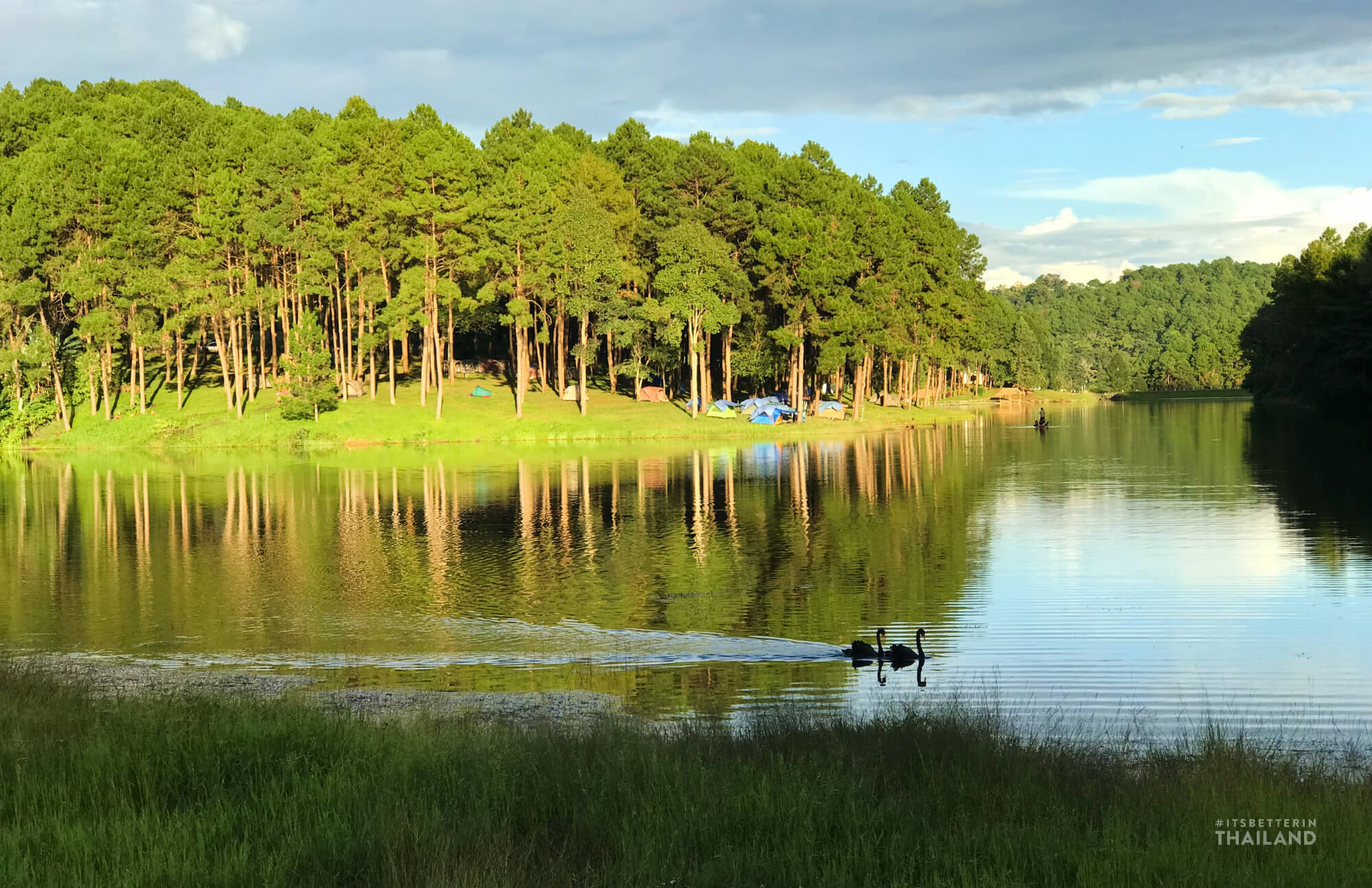
Pang Ung - A pine-ringed reservoir that looks like Switzerland, 40 km north of Mae Hong Son on the way to Baan Rak Thai, up a road that’s steep in places. The camping here is the best on the loop (300 baht to rent a tent, 30 with your own), with morning fog on the lake and bamboo rafts for 150-200 baht. It’s a Thai destination, not a farang one, so it’s busy at weekends and holidays and quiet on weekdays.
If you’re short on time, skip Baan Rak Thai and prioritise Tham Lod instead.
Tham Pla (Fish Cave) - A pool of huge sacred carp under a cliff, 17 km north of Mae Hong Son, 100 baht. It’s a 10-minute stop, mildly interesting, and on the way into town so you’re not going out of your way.
Mae Hong Son
Mae Hong Son is the provincial capital and the largest settlement on the loop outside Chiang Mai, but it feels like a sleepy Shan (Tai Yai) border town with no banana pancake stalls and no Full Moon Party. That’s the appeal. Give it a full day, or two with the Baan Rak Thai detour.
Jong Kham Lake - The postcard shot: two Burmese-style temples (Wat Jong Kham and Wat Jong Klang) reflected in the still water early in the morning. Wat Jong Klang’s glass paintings and wooden dolls of Buddhist mythology are genuinely interesting if you take 20 minutes to look.
Wat Phra That Doi Kong Mu - Two white chedis on the hill above town with valley views. Best at sunset.
Morning market - Real local market, not tourist tat. Best breakfast on the loop. Shan tofu (a chickpea-based tofu unique to the region), khao soi with Shan-style sauce, sticky rice in banana leaves, fried insects and Yunnanese buns. Get there by 6am, as it wraps up by 8am. This is one of the best morning markets in northern Thailand.
Su Tong Pae bamboo bridge - 500 metres of bamboo over the paddies to a small temple, 12 km out. Go at 6-7am for the light and the monks’ alms round.
Pha Sua waterfall - A multi-tiered waterfall 26 km north through Karen villages, 100 baht. Best in the rainy season.
In the evening, eat near the lake.
Bai Fern Restaurant - Thai and Shan food a block from the lake. Popular with the few tourists who make it here. Reasonable prices.
Salween River Restaurant - Thai food, near the lake. Good green curry.
Lake side stalls - Evening food stalls appear around Jong Kham Lake. Cheaper than the restaurants and just as good.
Friend House is 300-600 baht. Basic but clean. Some have lake views. Pana Huts and Mountain Inn are 600-1,500 baht. Better beds, some have pools. At 1,500-3,500 baht there’s the Imperial Mae Hong Son Resort or Fern Resort, a forest eco-resort outside town. Fern Resort is genuinely good if you want to treat yourself after days on a bike.
Day 3/4: Mae Hong Son to Mae Sariang (162 km)
This is the leg that most people rush, and that’s a mistake. Route 108 south is gentler, with fewer hairpins and less fog, and runs near the Myanmar border past Karen and Shan villages, with stretches where you won’t see another vehicle for 20 minutes.
Pha Bong Hot Springs - 10 km south of Mae Hong Son and quieter than the springs near Pai, with mineral pools at different temperatures for 50-100 baht. Good for stiff legs after a day on the bike.
Khun Yuam - A small town about halfway. There’s a decent noodle shop on the main road through Khun Yuam. Fill up on fuel here too - the next stretch is long.
Thai-Japan Friendship Memorial Museum - This one is genuinely interesting. Most of the Japanese soldiers who retreated through Khun Yuam in WWII died of malaria, dysentery and starvation, and local Thais buried them and kept their swords, helmets and photographs, which are on display here. It’s small but moving. Entry 50 baht.
Sunflower fields (mid-November to early December) - Wild sunflowers (dok bua tong) cover the hills, best seen from Doi Mae Ukho viewpoint, 25 km from Khun Yuam. It’s the single best visual on the entire loop, and the timing is perfect because November is also the best riding month.
Mae Surin Waterfall - One of Thailand’s tallest single-drop waterfalls at roughly 180 metres, 40 km each way down a winding side road. It’s best in the rainy season (September-October) but still flows in November-December. We’d only do the 80 km round trip with 6+ days and clear weather. You won’t feel like you missed something life-changing.
Mae Sariang
Mae Sariang is a quiet town on the Yuam River near the Myanmar border, with no backpacker bars. There’s not a lot to do here, and that’s the point: two Burmese-style temples (Wat Jong Sung and Wat Si Bunruang), a riverside promenade and a morning market with sticky rice, grilled pork and som tam. Mae Sariang goes to sleep early.
Inthira Restaurant - On the main road. Thai food, some Western options. Reliable.
Riverside restaurants - A few places line the Yuam River. The food is average but sitting by the water is pleasant.
Mitaree Guesthouse is 250-500 baht. Basic rooms, friendly staff. The Riverhouse Hotel and the nicer Riverhouse Resort, with a pool, are 1,100-1,500 baht, clean with hot water.
Day 4/5: Mae Sariang to Chiang Mai (196 km)
The last leg has two versions. Either way, fill up in Mae Sariang and again in Hot district.
The better route goes east on Route 108 through Hot and up Doi Inthanon, Thailand’s highest peak at 2,565 metres (300 baht for foreigners, no petrol on the mountain). It adds maybe two hours, but it’s the best way to finish. It’s cold at the top. Genuinely cold. Bring a jacket.
The summit - A small stupa, the highest-point sign for the obligatory photo, a coffee shop and the 30-minute Ang Ka nature trail through moss-dripping cloud forest, unlike anything else in Thailand.
Twin pagodas (Naphamethinidon and Naphaphonphumisiri) - Built for the King and Queen at about 2,200 metres. The gardens are maintained to a standard that feels out of place on top of a mountain. Valley views when it’s clear, but fog is common.
Wachirathan Waterfall - Right off the road, free with park entry. The spray soaks you from 30 metres away, which feels great after hours on a bike.
Mae Ya Waterfall - Often cited as one of Thailand’s most beautiful, with multiple tiers over a wide cliff, 14 km each way off the main park road. It’s best in the wet season but still impressive in November-December.
Sirithan Waterfall - A kilometre or so further up, seen from a viewpoint. Less dramatic than Wachirathan.
The big waterfalls have food stalls. From the park it’s about two hours downhill through orchards and paddies to Chiang Mai.
The faster route stays on Route 108 through Hot. It’s flatter and less interesting, and gets you back in 3-4 hours, which is what you want if you’re tired of curves, low on time or the weather has turned. Ob Luang Gorge, a national park with a river canyon about 20 km before Hot, is worth a quick walk to the viewpoint (100 baht). Most people drive past it, which means you’ll have it mostly to yourself.
You’ll probably arrive mid-afternoon. Return the bike before dark so you can check it over with the shop in good light. A Chiang Mai khao soi from Khao Soi Khun Yai tastes particularly good after a week of fried rice at roadside stalls.
When to go
November to February is best, with cool, dry weather, clear views and the Khun Yuam sunflowers in November.
Avoid March and April. That’s burning season, when farmers burn their fields, smoke blankets the mountains and some years the air quality hits hazardous levels. Avoid May to October too. It’s rainy season, the roads are slippery, landslides happen, and riding mountain switchbacks in a tropical downpour is dangerous.
How much it costs
Here’s a realistic budget for 5 days on the loop, per person, assuming you’re sharing accommodation and splitting bike rental with a partner:
| Category | Budget | Mid-range |
|---|---|---|
| Bike rental (5 days) | 1,500 baht | 2,500 baht |
| Fuel | 300 baht | 500 baht |
| Accommodation (4 nights) | 1,200 baht | 3,000 baht |
| Food | 1,500 baht | 2,500 baht |
| Activities/entry fees | 500 baht | 1,500 baht |
| Total | 5,000 baht | 10,000 baht |
Solo travellers will spend more on the bike and accommodation.
What to bring
Pack a rain jacket (mountain weather is unpredictable even in dry season), warm layers for the mornings, sunglasses or clear glasses against wind, dust and bugs, a basic first aid kit and enough cash to reach the next town, as ATMs are only in the major towns.
Bring your own helmet if you want something decent. Rental helmets are often terrible. A basic one costs 600-800 baht in Chiang Mai.
Navigation and phone signal
Google Maps works fine, but signal drops out in the mountains, so download the offline map for Mae Hong Son province before you leave, with Maps.me (fully offline, more side-road detail) as a backup. AIS has the best coverage in northern Thailand. True (now merged with dtac) drops out more between Mae Hong Son and Mae Sariang, so buy an AIS SIM for this trip. Expect 4G in the towns and nothing on some passes.
Holding your phone while riding is stupid and illegal, so get a handlebar mount (200-500 baht). The RAM mount style with a rubber grip is the most reliable. Cheap suction cup mounts vibrate loose on mountain roads. Bring a power bank for the GPS (200-400 baht for 10,000 mAh at 7-11).
If something goes wrong
Bike accidents on the loop happen. Most are minor - road rash from dropping the bike on gravel, a bruised knee from a low-speed tip. Some are serious. If you crash:
- Get yourself and the bike off the road.
- If anything feels broken or you’re bleeding heavily, don’t move more than you need to and call 1669, Thailand’s emergency medical number. Response times in remote areas can be 30 minutes to over an hour.
- Mae Hong Son has a government hospital, and Pai and Mae Sariang have small ones. For anything serious, get to Chiang Mai (Maharaj Nakorn, Chiang Mai Ram).
- Call your travel insurance as soon as you can.
- Photograph the scene, the bike and your injuries, and get a police report if another vehicle was involved. Without documentation, insurance claims go nowhere.
If you damage the rental bike, pay for repairs (with quotes from other garages, not just the shop’s) or lose your deposit. Pharmacies in Pai, Mae Hong Son, Khun Yuam and Mae Sariang have the basics, but bring any prescription medication from Chiang Mai.
The completion certificate
This is wonderfully Thai: the Mae Hong Son Tourism Business Association issues official completion certificates for anyone who finishes the loop. Take proof (photos with dates work fine) to their office in town. Is it cheesy? A bit. Will you frame it anyway? Probably.