Phitsanulok
Phitsanulok (พิษณุโลก) sits in the Upper-Central Region of Thailand and even has a small finger of land that extends to the Lao border. Much of the province is fertile land dotted with canals and rice fields, while some areas have mountains, national parks, and scenic plateaus.
Introduction
Phitsanulok is a city and province in the lower North of Thailand. There is not much in the way of tourism here and most travelers use the city as a jumping off point for visiting Sukhothai to the west, or Khao Kho in Phetchabun to the east. The city is fairly large and has an airport and train station making it something of a transportation hub for the surrounding area.
Recommended for
- Nature lovers
- People who like to get off the beaten path
Getting there
As a transportation hub, it’s quite easy to get to Phitsanulok.
By bus – Buses go regularly to and from Mochit Northern Bus Terminal in Bangkok to Phitsanulok. The journey takes 6-7 hours. There is also regular service to and from Chiang Mai.
By plane – Air Asia, Nok Air, and Thai Lion Air all serve Phitsanulok Airport (PHS) from Bangkok Don Mueang (DMK)
By train – Phitsanulok is a major station on the Northern Line with frequent service from Bangkok and Chiang Mai. Check train times and online booking options on SRT D-Ticket.
Where to stay
We find our accommodation on Booking.com by first searching for the town or province and our dates, we then filter out any rooms with a score lower than 7 or 8 (depending on availability) as well as any rooms out of our budget. After this, we open the map and hover over all of the pins in the rough location we already decided we want to stay in. Hovering over the pins gives us the price for x nights plus the review score. We click on each pin to open those hotels in a new tab, review them and book our favorite.
Getting around
By motorbike – We had a car when we visited, but it looks like there is a shop that rents motorbikes in Phitsanulok right by the train station. Their website is in Thai but shows the location and phone number.
Tuk-tuk – If you come without your own transport, you’ll have to rely on tuk-tuks which should be easy to find. Just be sure to agree on a price first.
What to do
Explore the city – Phitsanulok city doesn’t really have that much to do, but there is a riverfront and a famous temple along it. Unless you are really into temples though you could easily skip this.
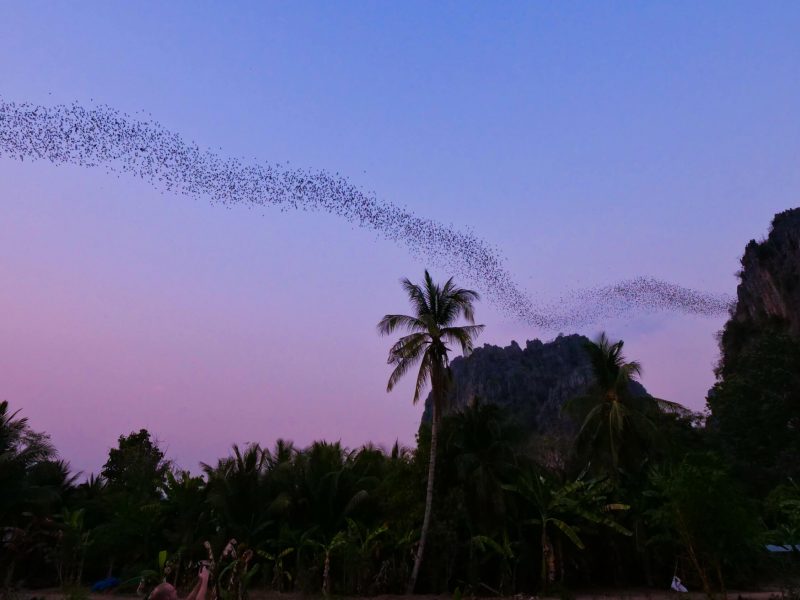
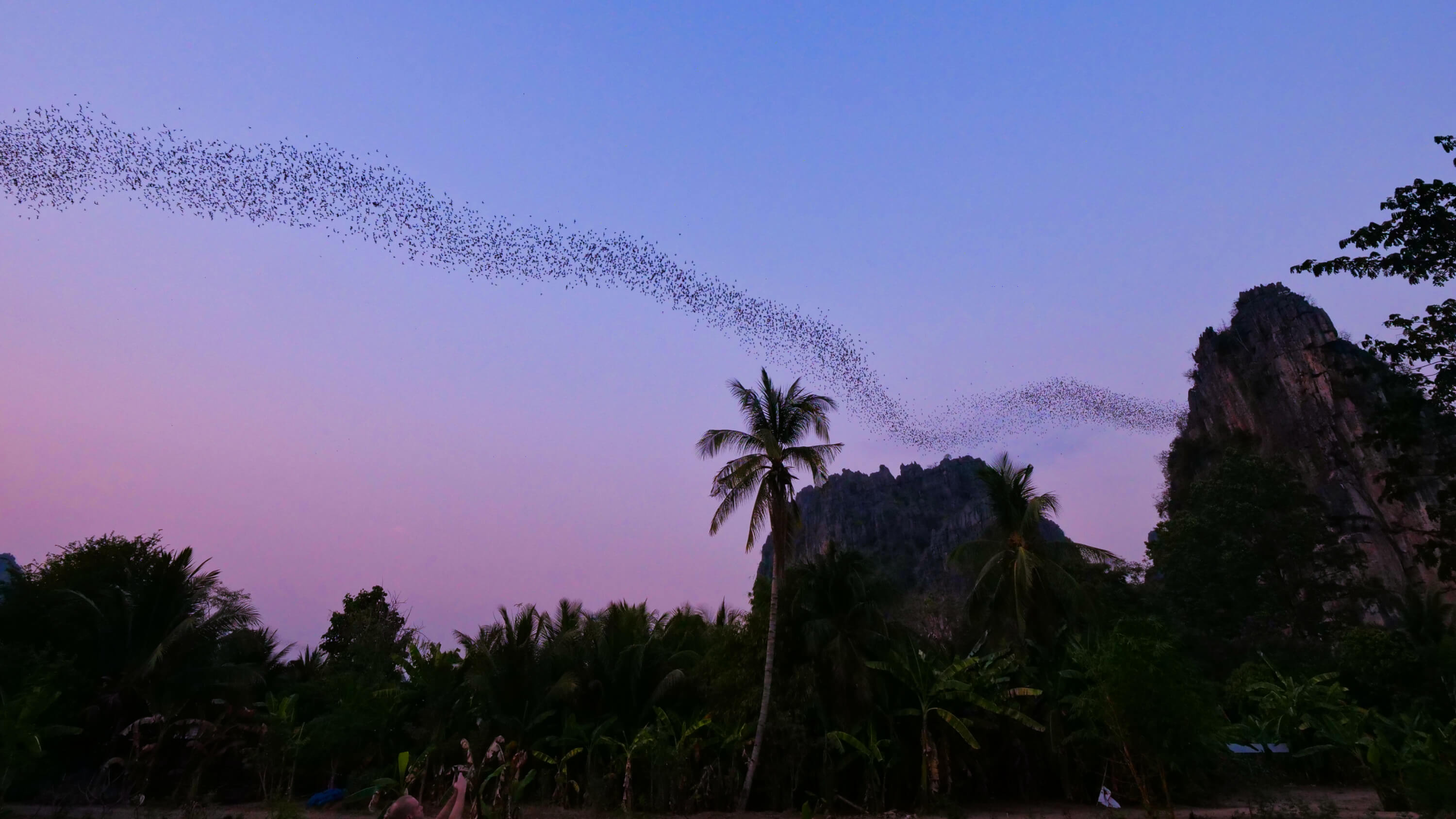
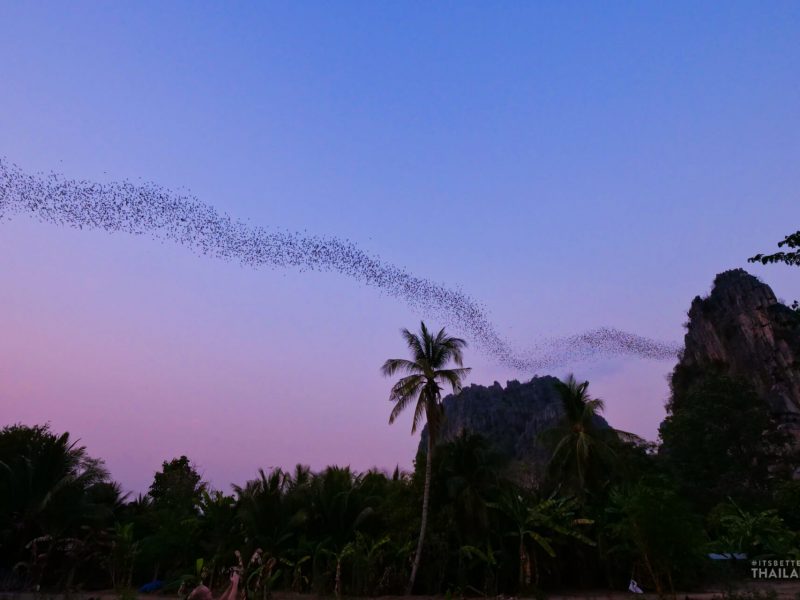
Flying bat spectacle – An hour southeast of the city in a beautiful and mountainous area there is an amazing scene every night as a million bats fly out of a cave in a thin ribbon that dances across the sky. Check out our guide to seeing the bats in Phitsanulok for everything you need to visit and a video of the spectacle.
Thung Salaeng Luang National Park – This park is technically in Phitsanulok, but access is from Phetchabun Province. It’s around a two-hour drive from Phitsanulok City to the entrance. You need a four wheel drive vehicle to get into the park beyond the initial area with a visitors center and small campground. At the 500 Baht foreigner entry price recorded in our original guide, this was the most expensive national park we’d seen anywhere in Thailand and one we really just couldn’t recommend.
Phu Hin Rong Kla National Park – We originally listed an exorbitant 500 Baht entry fee for foreigners here (again the most expensive we’d seen anywhere). It looks like they have some interesting rock formations, but we couldn’t be bothered to go. It’s around a two-hour drive out of the city.
Check current entry fees with both parks before travelling; the 500 Baht figures above are from our original guide.
Khao Kho – If you do head into Phetchabun Province toward Thung Salaeng Luang National Park, you will pass through the beautiful mountainous area of Khao Kho. This is close enough to Phitsanulok to be done as a day trip, but really you should spend at least a night up here for the cool weather. If you go here, check out our guide to Khao Kho.
Nightlife
Phitsanulok city has a surprising number of bars and nightclubs. As we were driving in we were kind of shocked by just how many there were right along the main road. It won’t be hard to find a place.
Fitness & gym
We really liked Fitness no. 9, an airconditioned gym with everything you could need, and day passes for a great price. I can’t remember exactly what we paid but I believe it was 70 Baht or less.
Getting out
From Phitsanulok you are located very centrally and can easily travel to the North, to the east to Phetchabun and then on to the Northeast, south into Central Thailand, or west to historical Sukhothai.
When to go
Most of Thailand falls in to the generic high and low season categories, including Phitsanulok.
High season - begins in November and runs through to February, bringing cooler temperatures, lush greenery from the previous months of rain, good air quality, and less rain. The downside is larger crowds and sometimes higher prices for tours, flights and accomodation.
Low season - begins in July and runs through to October. During low season the temperatures are higher, the chance of rain and storms are higher. That doesn't mean it's a bad time to visit though, if you can be flexible, there are deals to be found on flights and accomodation.
Destinations like Phitsanulok in both northern and north eastern regions can be significantly cooler during the high/cool season than central and southern provinces like Bangkok or Phuket. It's a welcome and noticable change in season which may require a wardrobe change, especially at night.
As Phitsanulok is in the northern/north eastern region, it's important you consider the smokey/burning season which affects the north, north east and sometimes central/eastern provinces. You can find more information for current and historical air quality on aqicn.org.
Need more? Read our post discussing the best time to visit Thailand.
Where to stay
Instead of recommending hotels, we think it will be more useful to share our process so you can pick based on your own critera for location, budget and style.
We always start our search on either Booking.com or Agoda. They have an easy to user interface and have some extra benefits for "Genius" and "VIP" users. You can also sometimes pay with credit card in advance if you're playing the cashback or air miles game.


Process:
- Search for specific province, city or town.
- Apply rating filters for a minimum rating or either 7, 8 or 9.
- Apply other filters: budget, fitness, breakfast, etc.
- If you have a specific location in mind, use map view to browse and make a final selection.
If there are too many properties available to choose from, increase the rating filter for less, higher rated selections.
Final notes: Prices are dynamic. Check the same hotel on both Booking.com and Agoda to see which has the best deal at any given time (go through to checkout to make sure all VAT and service charges are factored in). You can go one step further by calling the hotel and checking the price for booking directly. In our experience this saves money 50% of the time but you have less guarantees.
Emergency contacts
Knowing an emergency number could save your own, or somebody elses life. Take a photo or save these numbers on your phone:
Police & emergencies - 191
Call 191 for police emergencies.
Tourist Police - 1155
The Tourist Police Bureau advertises 24-hour, multilingual assistance on 1155 (checked 7 September 2026).
Public Ambulance - 1669
Call 1669 for emergency medical assistance.
Fire Department - 199
Call 199 for fire emergencies.
Highway Police - 1193
If you plan on driving in Thailand, then you may end up needing to use this number if you break down in an unsafe place etc.
Posts
Our archive of posts from Phitsanulok
Videos
Our archive of videos from Phitsanulok
Activities
Our archive of activities and things to do in Phitsanulok